The work it expands
The agent handles exploratory and recurring questions that often sit between a dashboard and a request to the data team
- Compare periods and segments
- Investigate changes and possible causes
- Prepare a readout for a decision

AI data analyst
Rumbleo answers questions over internal data in natural language, compares results, and keeps investigating in the same conversation. The data team retains definitions and control
Questions, clarifications, and follow-ups in one conversation
Metrics and definitions shared across the company
Read-only access with permissions respected in every answer
A worked example of investigating a margin decline, comparing channels and checking missing evidence before attributing a cause.
Revenue is flat. Why has our margin fallen?
Revenue is unchanged at €100,000. Gross margin fell from 35% to 30%. The decline is concentrated in the online store.
| Channel | Revenue | Previous | Current |
|---|---|---|---|
| Online store | €50,000 | 40% | 32% |
| Stores | €50,000 | 30% | 28% |
| Total | €100,000 | 35% | 30% |
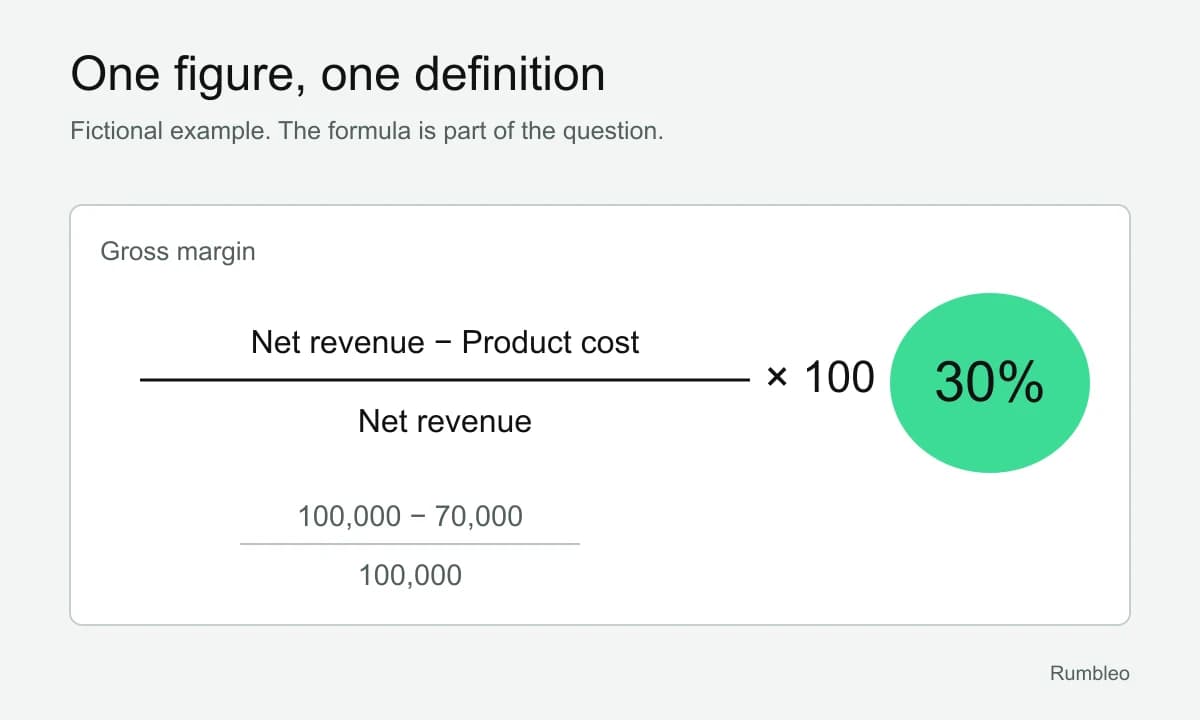
Gross margin = (net revenue − product cost) / net revenue. Like-for-like comparison periods.
Question 1 of 3: Revenue is flat. Why has our margin fallen?
The agent handles exploratory and recurring questions that often sit between a dashboard and a request to the data team
A reliable answer starts with shared definitions and a data connection prepared by the organization
The agent can investigate without changing permissions or taking control of the database
It is especially useful when a question needs comparison, follow-up, and an explanation beyond one number
Finance
Break down the variance by business unit, category, or component and validate hypotheses in sequence
Operations
Compare sites, suppliers, products, or periods through the dimensions available in the model
Growth
Explore acquisition, behavior, and change over time without requesting a new view for every cut
No. It reduces repetitive questions and expands access to analysis while the data team continues to define metrics and protect their quality
It should not. Rumbleo works with company-approved definitions and asks for context when a question has more than one valid interpretation
No. People ask in natural language and receive the analysis without writing or reviewing technical queries
A demo built around a decision
Bring a question that currently waits for the data team and we will explore how to answer it with your metrics and ways of working