
Preparing your data
What an AI analyst needs to know about your metrics
A practical specification for revenue, margin, and active customers before asking artificial intelligence to analyze your business.
Rumbleo team Updated
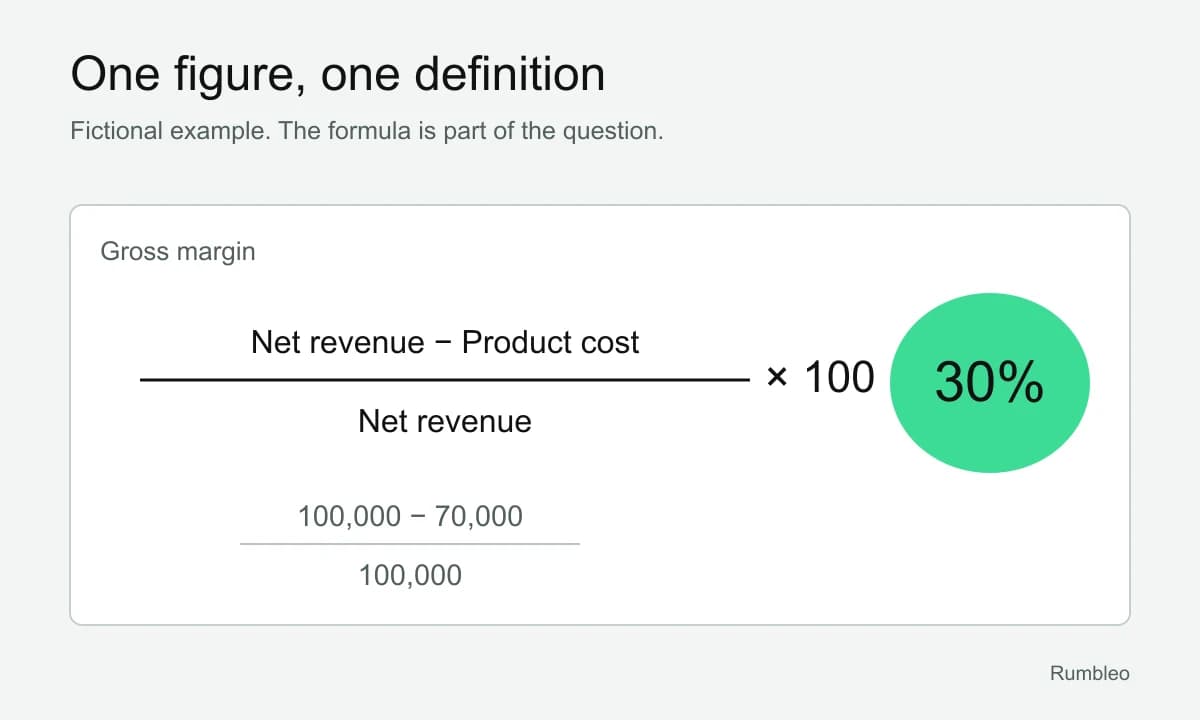
Two different answers can both be correctly calculated
September sales can mean orders created in September or invoices issued that month. If the business uses both views, name and distinguish them. Problems begin when both are labelled sales.
An assistant needs those decisions in writing. Database structure describes where data lives, but does not always explain how finance uses it or when operations considers an order complete.
Write a specification for each metric
Start with the metrics behind the team's first questions. Record the formula, period, filters, and the person who can resolve a discrepancy. Include a known result to test the definition.
| Field | Gross margin example |
|---|---|
| Formula | (Net revenue − product cost) / net revenue |
| Date | Invoice date |
| Exclusions | Tax and cancelled orders |
| Returns | Treatment agreed by finance |
| Zero denominator | No percentage when revenue is zero |
| Owner | Person designated by controlling |
Granularity belongs in the definition too
If revenue is recorded per order line and shipping per order, joining them without allocating shipping can multiply that cost. Document the level of detail of each amount and the relationships between datasets.
Aggregating percentages requires care. Combined margin uses total revenue and total cost; averaging product percentages without weighting may produce a different result. The margin example in these resources provides a check using two channels.
Agree on ambiguity handling
Not every question needs clarification. If the company has a default definition, the assistant can apply and explain it. If two interpretations change the decision and no default exists, asking before calculating usually saves work.
Record how the team names fiscal periods, currencies, and customers. A short glossary using the team's vocabulary is more useful than a long list of unexplained table names.
Maintain definitions after the pilot
Metrics change: returns move to a different accounting date or a channel is added. Each change needs an owner, an effective date, and a check against known results. Review recurring analyses that depend on the formula too.
Rumbleo uses the company's semantic model to interpret questions. Preparing it is shared work with the people who know the data. It avoids asking the assistant to guess business decisions.