
Preparing your data
Five data checks before trusting an AI analysis
A practical review of duplicates, totals, dates, relationships, and missing values to catch convincing answers built on unreliable data.
Rumbleo team
Start with a figure you already know
Choose a total your team has reviewed, such as net revenue for the last closed month. Save the amount, source, update date, and filters. That reference lets you check the complete analytical journey.
If two reports disagree, first establish the population each includes. An orders report and an invoices report can be correctly calculated while answering different questions. Asking an assistant to choose between them leaves a business decision unresolved.
Check what each row represents
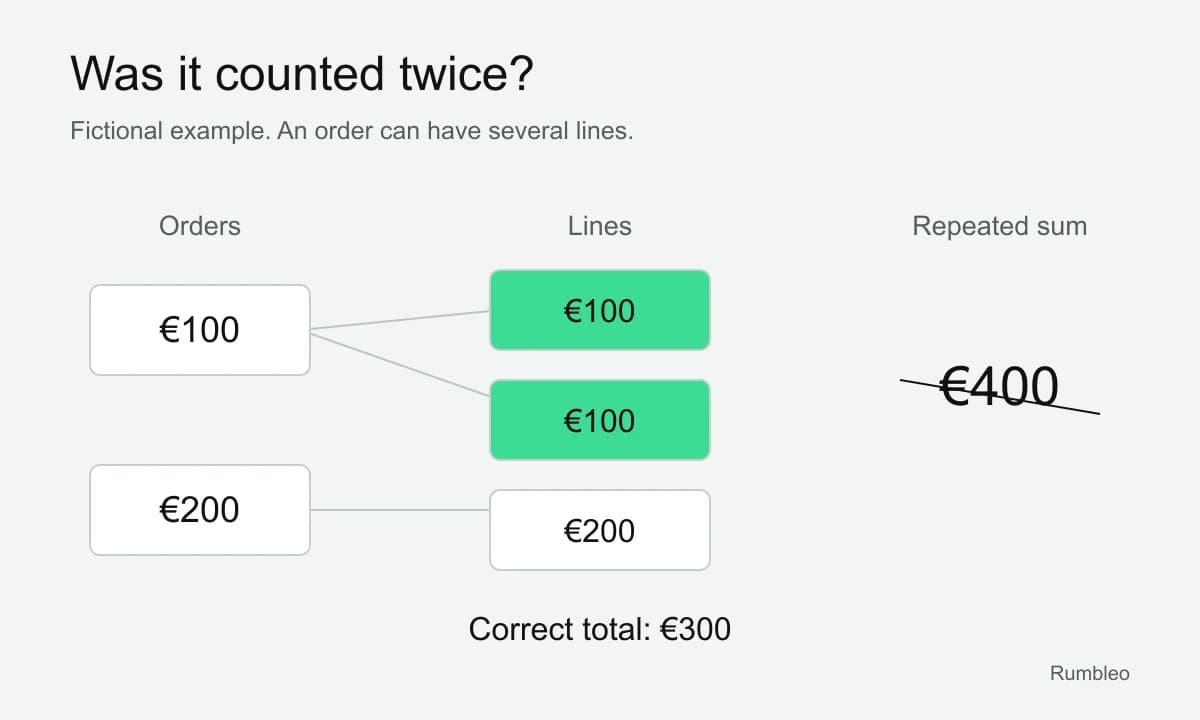
Consider a fictional €100 order with two lines and a €200 order with one. Joining headers to lines and summing the header amount on every resulting row produces €400 instead of €300. The first order has been counted twice.
Review the keys identifying orders, invoices, and lines. Count records before and after joining datasets and test the total with these two orders. Microsoft explains granularity and analytical models in its star schema guidance.
Distinguish zero from data that never arrived
An unknown cost is not a zero cost. Replacing it with zero makes a sale appear more profitable. Count missing values and show how much of the analyzed amount depends on them.
Apply the same check to unassigned categories and unidentified customers. Keep a visible unknown group where appropriate; silently excluding those records changes the population and can break reconciliation with the reference.
Align dates and update times
Record whether the period uses order, invoice, or shipment date. For daily comparisons, agree on a time zone and cutoff time too. A partial load can look like falling activity.
Check the last complete day, the most recent record, and any known source delay. If the dataset is incomplete, the analysis should explain its cutoff and avoid comparing a partial interval with a closed period.
Keep the checks so you can repeat them
Save a small reference set: a closed-period total, unique keys, order-to-line relationships, missing values, and update cutoff. Repeat it after changing a source or definition.
When testing Rumbleo, bring a known discrepancy and ask to narrow it by date or channel. A useful answer explains what could be checked and what remains unresolved. Convincing prose does not validate the underlying data.