
Sales
Why are sales falling? Separate price and volume before asking AI for an explanation
A worked example for separating unit and price changes, checking product mix, and asking useful follow-up questions about sales.
Rumbleo team
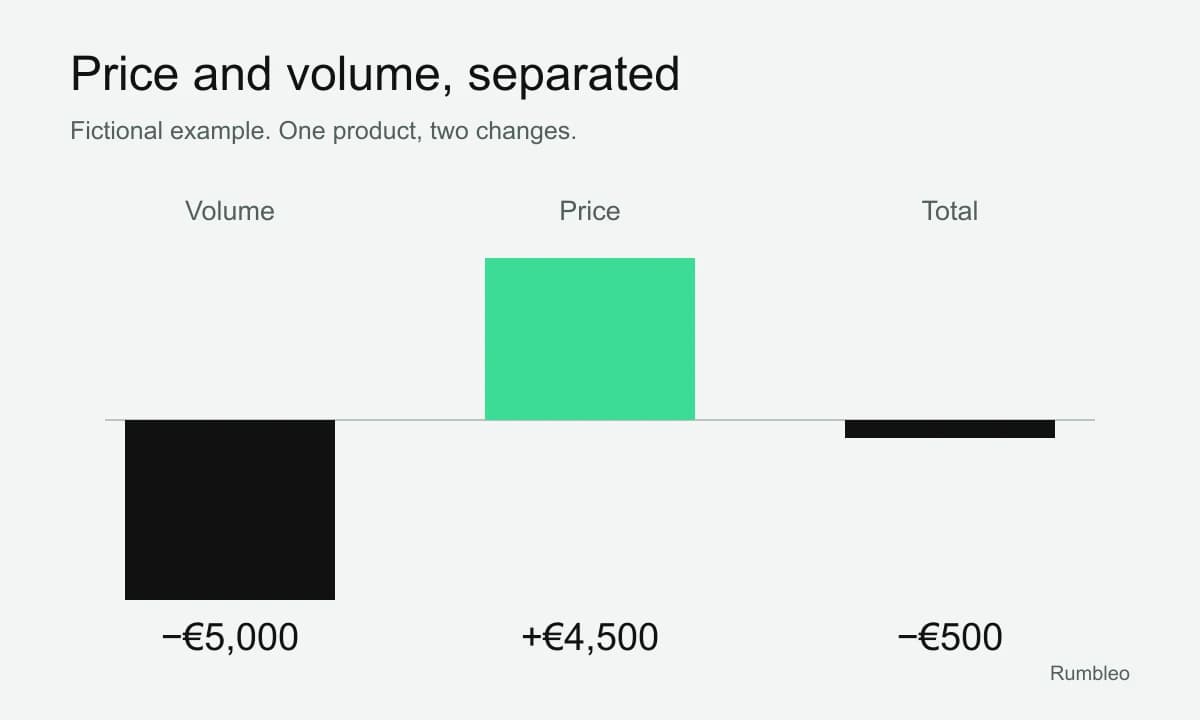
Revenue is measured in money; the explanation needs units
A report says sales fell by 1%. To decide whether to review pricing or investigate demand, you need to know what changed. Start with matching periods, a common currency, and a revenue definition that treats returns consistently.
Ask for a comparison by product and channel. Comparing a complete month with an unfinished one can introduce a calendar difference. Record the data cutoff: outstanding returns may arrive tomorrow.
A calculation you can reconcile
This fictional example uses one product. The previous period had 1,000 units at a net price of €50; the current period has 900 at €55. Revenue falls from €50,000 to €49,500.
We allocate the €500 decline in a stated order: change units at the previous price, then apply the price change to current units. Allocation depends on the method, so the answer should describe it.
| Step | Calculation | Change |
|---|---|---|
| Volume | (900 − 1,000) × €50 | −€5,000 |
| Price | 900 × (€55 − €50) | +€4,500 |
| Total | −€5,000 + €4,500 | −€500 |
Multiple products introduce mix
Selling more units of a cheap product and fewer of an expensive one can lower the combined average price without any individual price changing. Compare prices within products first and distinguish changes in their share of sales.
Changed product codes, bundles, and returns without units can disrupt the comparison. Identify those records and agree on their treatment before adding product contributions. The contributions should reconcile to the report total.
Follow-up questions that narrow the investigation
A useful request is: compare September and August net sales for the same products and channels; separate units and price using the example method and identify new or discontinued references.
Then ask which products account for the unit decline, whether it persists across comparable trading days, and how margin changes. A higher price can offset a revenue decline while still leaving less profit if costs rise.
A contribution does not establish a cause
The example identifies falling units. It does not establish whether pricing, unavailable stock, or a competitor caused the change. Investigating those hypotheses requires additional records, such as availability, promotions, and dates of price changes.
When evaluating an AI analyst, check that follow-ups retain periods and filters, explain the allocation method, and acknowledge missing data. Keep the €500 calculation as a reference for reviewing the answer.