
Choosing a solution
Conversational BI and dashboards: which work belongs where?
How to divide monitoring and exploration between dashboards and AI analysis, with example questions and practical evaluation criteria.
Rumbleo team Updated
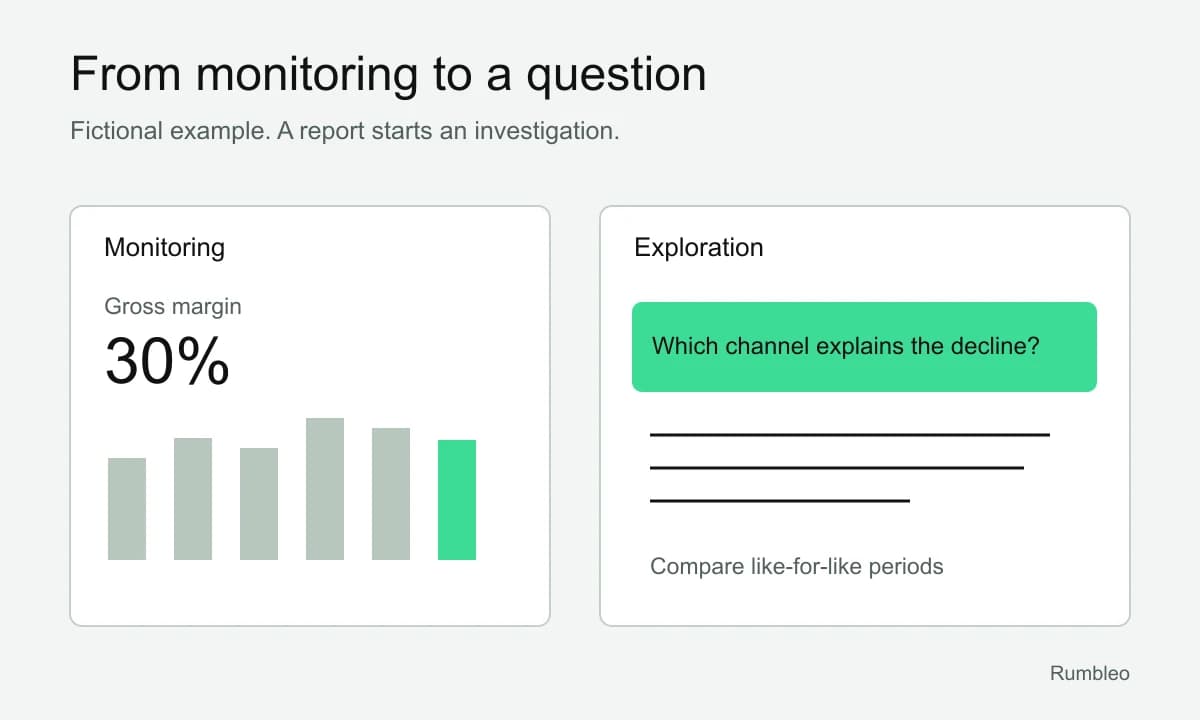
Monday starts with familiar numbers
Some questions recur every week: sales against target, outstanding orders, available cash. A dashboard puts them together in a stable view with agreed filters. If a report already handles that job, it is worth keeping.
Conversation becomes useful when a question appears that the report did not anticipate. Mobile conversion is down, but is it also down among returning customers from the latest campaign?
The difference is in the follow-up
A dashboard can support many breakdowns, but someone must prepare the data, calculation, and navigation. A conversational assistant lets users express a new combination in natural language. It still needs sufficient data and definitions to calculate it.
Neither interface fixes a poorly defined metric. If reports disagree, adding a chat without resolving those differences can multiply incompatible answers.
| Task | Starting point |
|---|---|
| Review agreed KPIs every morning | Dashboard |
| Investigate a segment raised in a meeting | Conversation |
| Distribute the same month-end report | Validated report |
| Explore possible drivers of a change | Conversation with checks |
When to keep the report
Recurring analysis with fixed distribution and reviewed calculations gains value from stability. Some tasks also require a specific visualization or formal approval before circulation. Choose based on those requirements, rather than how modern an interface appears.
In a demo, ask the vendor to show how to retrieve an analysis and what happens when a metric definition changes. An attractive screenshot says little about next month's work.
Where to try AI analysis
Look for recurring questions that currently become requests to the data team. They should have checkable answers and available data, but enough variation to make preparing a separate report for each expensive.
Rumbleo supports that exploratory work: asking, comparing, and following up in conversation over a read-only analytical database. The team remains responsible for metric definitions and important decisions.
Evaluate with the same questions
Try both approaches with real questions and record what the analyst prepared, what the user resolved, and what remained unanswered. Include review time. Fast text has limited value if checking it means reconstructing the entire analysis.
Start with one department and keep its dashboards. If conversation handles follow-ups with consistent figures, you will have evidence for expanding its use.